Affiliate disclosure: This independent research-based review includes affiliate links. We may receive a commission if you buy through them, at no additional cost to you. We have not tested this product firsthand.
Product Details
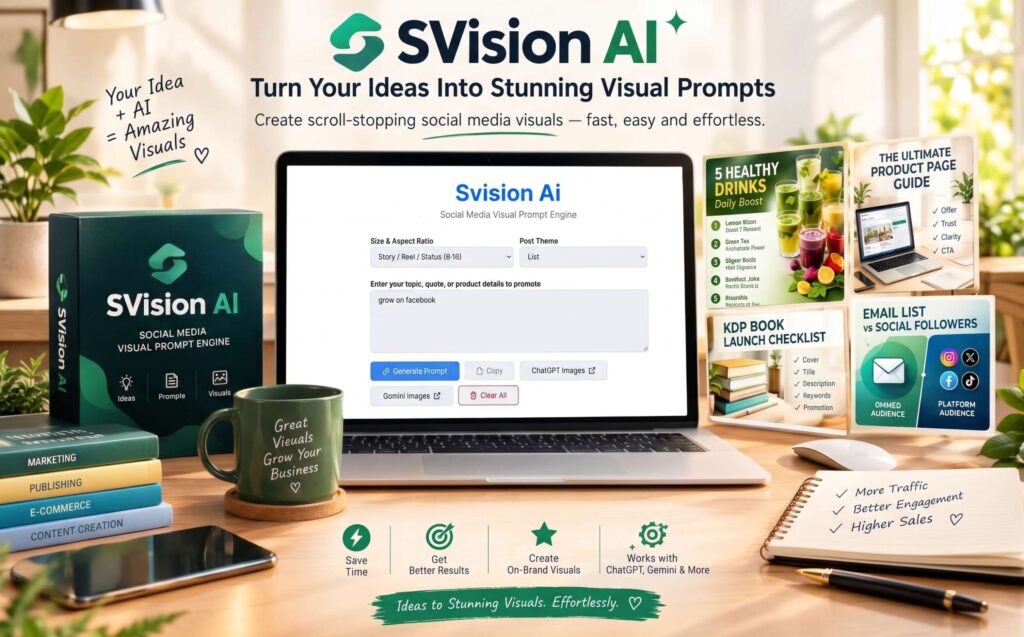
SVision AI turns your topic, idea, quote or product into a detailed, ready-to-use image prompt in seconds. Copy it into ChatGPT or Gemini. No design skills needed.
- SVision AI turns your topic, idea, quote or product into a detailed, ready-to-use image prompt in seconds.
- No design skills needed.
- AI & Software
- Product category: AI & Software
- Copy it into ChatGPT or Gemini.
- Buyer check: compare the official feature list with your needs.
SVision AI Review — Quick summary: verified source records confirm the product name SVision AI and an official product page, but the supplied source packet does not include feature, pricing, deliverables, or refund details. This review explains what is known, what is not verifiable from the available material, questions to ask before buying, and reasonable alternatives to consider.
Related reading: How to Write AI Image Prompts for Product Photos · How to Craft Pinterest-Style Image Prompts
Product Video
Video detected on the vendor sales page. Availability and video content remain controlled by the vendor.
Reference: FTC endorsement and review guidance.
Quick verdict
Bottom line: SVision AI is advertised as a tool for turning a topic, quote or product idea into a reusable image-generation prompt for services such as ChatGPT or Gemini. That advertised workflow is relevant if you create social graphics or product imagery, but we have not independently tested the software or validated its performance. We could not establish the current total price, license scope or refund terms from the materials available for this review. Compare a sample prompt against one written manually before paying, and confirm the full checkout terms with the seller.
What is SVision AI?
SVision AI is presented in the product information available to us as an image-prompt assistant: you provide an idea, topic, quote or product, then use the resulting prompt in an image generator such as ChatGPT or Gemini. This describes the advertised workflow, not a capability we have independently verified. Before buying, check whether you receive a prompt generator, prompt templates or a separate image-generating service; these are different deliverables.
What we could not verify from the supplied sources
- Exactly which advertised prompt-building capabilities are included in the purchased package, how they work in a live demonstration, and whether image generation itself is included.
- Supported platforms, export formats, or system requirements (not provided).
- Exact pricing, license types, subscription or one-time fee (not provided).
- Refund policy, trial period or guarantee (not provided).
- Customer support channels or SLA details (not provided).
- Any independent user testing, benchmarks or user counts (not provided).
How this review was created
Method: We reviewed the available product listing and the advertised image-prompt workflow. We did not receive access to a paid account, run a benchmark, or independently validate output quality. References to turning topics into image prompts describe the seller-facing marketing material, not an experimentally verified result. Current checkout price, support conditions, license limitations and refunds should be confirmed directly with the vendor.
Key features to verify and buyer questions
- What exact features does SVision AI include? (Look for a documented feature list and screenshots.)
- What is the pricing model and are there recurring fees? (Confirm on the official sales/pricing page.)
- Is there a refund policy or trial? (Verify the vendor’s refund terms.)
- What support channels are available (email, chat, ticket, phone)?
- Which platforms and output formats are supported (desktop, web, mobile, video formats)?
- Are there clear license or commercial-use terms for content produced with the product?
Pros and cons (based on available evidence and reasonable analysis)
Pros
- Potential convenience, if the advertised workflow works: structured prompts may reduce the effort needed to describe an image idea in detail.
- Workflow compatibility: the offer describes copying prompts into existing image generators, which may suit people already using those tools. Confirm that the output is editable and exportable before purchasing.
Cons / Limitations
- Price, refunds, purchase contents and any recurring charges were not established from the material reviewed.
- Cannot independently verify vendor claims or product performance from the provided evidence.
- Potential for unknown additional costs (upsells, credits, usage limits) because pricing details are absent.
Who might consider SVision AI (based on typical buyer intent)
Because the supplied materials are limited, treat this as conditional guidance: people who research SVision AI should be prepared to verify features and pricing before buying. Likely candidate profiles to investigate further include:
- Marketers and creators looking for AI-assisted media tools — but only after confirming the exact feature set.
- Small teams wanting faster content workflows — if integrations and commercial‑use rights are confirmed.
- Buyers comfortable verifying technical requirements and refund terms before purchase.
Who should probably avoid buying without more evidence
- Anyone who needs clear pricing, refund protections or enterprise SLAs immediately — verify those before committing.
- Users who require documented third‑party integrations or guaranteed uptime — confirm compatibility with your stack first.
- Buyers who rely on independent third‑party reviews or test results — none were supplied in the source packet.
Alternatives and comparison approach
Because SVision AI’s documented features are not available in the supplied sources, compare any vendor claims on the official product page to better-known competitors in your category (search for established AI tool vendors that publish clear feature lists, pricing tiers, and trials). Focus comparisons on:
- Feature parity (what each tool actually does)
- Pricing transparency and recurring costs
- Commercial-use licensing
- Support and documentation
Decision checklist — five quick questions before you buy
- Does the official product page list all features and include screenshots or demos?
- Is pricing transparent with clear licensing (monthly vs. one-time)?
- Is there a documented refund policy or trial period you can test risk-free?
- Are support response channels listed and verifiable?
- Do the terms grant the commercial rights you need for content created with the tool?
FAQs
Is SVision AI a real product?
Verified fact: SVision AI is listed by name and an official product page URL was supplied in the source packet. Beyond that, additional product details were not supplied and must be confirmed on the vendor page.
Does this review include hands-on testing?
No. The supplied source packet did not include first‑hand testing evidence. This review is based on the verified product name and page URL plus editorial analysis about what buyers should verify.
How can I verify pricing and refunds?
Visit the official product page linked in the source packet and look for a pricing or terms page. If pricing or refund details are not published, contact vendor support or request clarification before purchasing.
Practical use-case guidance: How to decide whether to investigate SVision AI further
Because the source material confirms only the product name and an official page, the first objective is to determine whether SVision AI could realistically meet your needs. Use the short workflow below to triage suitability before spending time on demos or trials.
- Define the problem you expect the tool to solve. Be explicit: do you need automated image/video editing, transcription, visual search, content generation, analytics, or something else? Write a one-sentence statement such as “reduce manual video tagging time by 50%” or “generate product imagery for ecommerce.”
- Map required outputs and formats. List the exact file types, resolutions, metadata fields, or API endpoints you need. If you require final deliverables in MP4, PNG, JSON metadata, or direct CMS uploads, note those upfront.
- Identify integration points. Note the systems the tool must connect with (e.g., cloud storage, DAM, CMS, collaboration tools, CI systems). Prioritize which integrations are mandatory vs. nice-to-have.
- Set success criteria. Choose measurable acceptance criteria: processing time per asset, accuracy thresholds, acceptable manual correction rate, throughput, or cost-per-output limits. These criteria make vendor claims testable during a trial.
Only if SVision AI’s official materials show potential alignment with your problem, outputs and integrations should you proceed to request more detailed information or a demo from the vendor.
Workflow guidance: How to evaluate SVision AI with a short, practical pilot
If you decide to run a pilot (trial, demo, PoC), structure it so you can answer whether SVision AI meets your requirements. Below is a lightweight pilot plan you can ask a vendor to accommodate or run internally if the vendor provides trial access.
Pilot scope and duration
- Choose a representative sample of 10–50 assets or tasks that reflect the range of complexity you expect in production (simple, medium, complex).
- Limit the pilot to a short, defined time window (one to four weeks), but ensure it includes enough variation to surface edge cases.
Data and privacy setup
- Confirm how assets will be uploaded and stored during the pilot and whether they will be deleted afterward.
- Request a clear statement from the vendor on data use, retention, and whether they train models on your data (if applicable). If such statements are not published on the product page, ask the vendor directly in writing.
Test tasks and metrics
- Define one or two primary tasks (e.g., auto-captioning accuracy, object detection precision, render quality) and set pass/fail thresholds.
- Measure performance against your pre-defined success criteria (see above). Collect both quantitative results and qualitative notes about atypical failures.
Operational and support evaluation
- Assess how the vendor supports setup: do they provide documentation, an onboarding call, or a technical contact?
- Note response time and helpfulness of support during the pilot; these are often predictive of long-term vendor responsiveness.
Integration and technical checklist
Before purchasing any AI-powered media tool, confirm these technical details. If they are not present on SVision AI’s product pages, ask the vendor or include them in a statement of work.
- Supported input/output formats and maximum file sizes.
- Available APIs, SDKs, or webhooks and whether they are documented publicly.
- Authentication methods (OAuth, API keys, SSO options) and user provisioning capabilities.
- On-premises options or private-cloud instances if you have data residency requirements.
- Latency and throughput expectations for batch and real-time workflows.
- Logging, audit trail, and error-handling behaviors for automated pipelines.
Cost and procurement considerations (non‑numeric guidance)
The supplied sources do not include pricing details. When pricing information is absent, vendors can structure costs in many different ways, and buyers should plan to verify the following kinds of terms:
- What billing model is used (subscription tiers, usage-based credits, per-seat pricing, or a hybrid)?
- Are there any soft limits (API rate limits, per-month processing caps) that require upgrade or additional fees?
- Are integrations or custom work included in base pricing or quoted separately as professional services?
- Clarify minimum contract terms and renewal/termination conditions. If the vendor cannot provide this information up front, request it in writing before committing.
Risk assessment and mitigation steps
Given the limited verified information, take a conservative approach to mitigate procurement risks. Consider these actions before you sign any agreement with a relatively unknown supplier.
- Require a written trial or pilot agreement that defines deliverables, data handling, and exit conditions.
- Avoid long-term commitments until the pilot proves the product in your environment.
- Ask for references or case studies that can be independently reached and verify the vendor’s claims.
- Have a rollback plan to return to prior workflows if the integration or output quality is inadequate.
Buyer-fit profiles: who should prioritize further investigation
Below are conditional buyer profiles describing when a deeper investigation of SVision AI might be worthwhile. These profiles assume you will verify the product’s details on the vendor page or through direct contact.
Good candidates to investigate further
- Teams with flexible evaluation timelines who can run a short pilot and compare outcomes against clear success criteria.
- Organizations that can tolerate limited initial documentation but require strong vendor responsiveness and fast support during onboarding.
- Creative teams seeking potential AI workflow improvements and willing to validate content licensing and quality before scaling.
Less suitable candidates (without further verification)
- Enterprises that require published SLAs, compliance certifications, or predictable long-term pricing up front.
- Buyers who need extensive third-party integration documentation or audited security practices before procurement.
- Users who cannot accept uncertainty about data usage or model training policies.
Comparison framework: How to compare SVision AI to established competitors
When specific feature lists are not yet known, a structured comparison framework helps you evaluate any vendor claim objectively. Use the sections below to compare SVision AI (after obtaining vendor details) against alternatives.
Functionality and accuracy
- Compare feature parity: does each tool offer the exact sub-features you need (e.g., batch processing, metadata tagging, multi-language support)?
- Ask for accuracy or quality measurements you can replicate on the same asset sample to ensure apples-to-apples comparison.
Integration and extensibility
- Evaluate available APIs and how easily the tool plugs into your existing pipelines.
- Assess whether custom workflows require professional services and compare estimated implementation time and cost.
Operational and commercial terms
- Compare pricing transparency, overage terms, and any usage caps that could impact scale.
- Review support SLAs, uptime commitments, and escalation processes for critical incidents.
Common pitfalls to watch for during evaluation
- Assuming feature parity: vendors may use marketing language that seems to imply functionality not actually available. Insist on feature demos with your own sample data.
- Neglecting data governance: not clarifying how your assets will be used or retained can lead to compliance issues later.
- Underestimating total cost: initial subscription fees may exclude integration work, storage, or per‑GB processing fees.
- Ignoring edge cases: a system that performs well on typical inputs may fail unpredictably on the rarer asset types you still need to support.
Negotiation checklist and contract items to request
If you reach the contracting stage, these are reasonable things to ask for or clarify in writing:
- Definition of accepted deliverables for the pilot and the acceptance criteria.
- Data handling and deletion commitments, including whether your data may be used to train vendor models.
- Detailed pricing schedule including any usage tiers, overages, and professional services fees.
- Support and escalation process with estimated response times for high-priority issues.
- Termination and transition assistance clauses that describe how to export your data and shut down the service.
Implementation planning: roles, training, and timelines
Even without product specifics, planning for implementation clarifies internal readiness. Consider these practical steps:
- Identify an internal project owner to manage vendor communication and pilot execution.
- Assemble a small cross-functional pilot team: one technical lead, one business owner, and one quality reviewer.
- Schedule an onboarding window that includes time for integration, validation, and iterative feedback with the vendor.
- Plan a short internal training session for end-users that will review how to use outputs and how to report quality issues.
Extended FAQs — What to ask the vendor (example questions)
Use the list below as an interview guide when you contact the vendor or review the product pages. These questions are designed to uncover the key details missing from the supplied sources.
- Can you provide a full, itemized feature list and any limitations for each feature?
- What file formats and maximum file sizes are supported for input and output?
- Do you offer an API or SDK, and is the documentation publicly accessible?
- What is your pricing model and what is included vs. billed separately?
- Do you provide any trial, money-back guarantee, or pilot agreement terms?
- How do you handle customer data: retention, deletion, and use for model training?
- What support channels are available and what are typical response times?
- Can you provide customer references or case studies that we can contact?
- Are there any known limitations or common failure modes we should plan for?
- Do you offer SLAs or uptime commitments for paid customers?
If answers are unavailable: next steps for cautious buyers
If the vendor provides incomplete or evasive answers to the questions above, proceed cautiously. Reasonable next steps include:
- Requesting a short written summary of any verbal commitments and adding them to the pilot agreement.
- Searching for independent user discussions or third-party reviews outside the vendor’s site to corroborate claims.
- Choosing a short, low‑cost pilot rather than a multi-year commitment until the product has been validated in your environment.
How to document your evaluation for future procurement decisions
Capture the following information during any trial or negotiation so your organization can make a reproducible, defensible decision:
- Pilot dataset description and test results against your acceptance criteria.
- Time and effort required for integration and onboarding.
- Support responsiveness and quality of vendor documentation.
- Detailed cost estimates including any professional services or fees uncovered during negotiation.
- Risk register summarizing data, security, compliance, and vendor-lock concerns.
These sections are intended to complement the original review by equipping readers with practical, evidence‑based steps to evaluate SVision AI (or any similar offering) when product specifics are not initially disclosed. Because the supplied source packet contains only the product name and a product page URL, all product-specific claims must be verified directly with the vendor, and the guidance above focuses on verifiable evaluation steps rather than assumed features or performance.
Final verdict — Is SVision AI worth considering?
Short answer: maybe — but only after you verify key details on the official page. The supplied source packet confirms the product name and page exist, but it does not provide the feature, pricing, refund, support or deliverable information needed to make a confident buying decision. Use the decision checklist above and require transparent documentation from the vendor before purchasing.
Bought SVision AI Through Our Affiliate Link? We’re Here to Help
If you purchased SVision AI through our affiliate link and you experience any problem with the product, you are welcome to contact us.
Whether you need help with installation, accessing the product, understanding how a feature works, contacting the product owner or vendor, reporting a technical problem, locating your purchase, requesting a refund, or dealing with another issue related to SVision AI, we will do our best to guide you toward the appropriate solution.
You can contact ReviewScoutLab directly:
WhatsApp: +91 7889856565
Email: support@reviewscoutlab.com
We want readers who purchase through our affiliate links to know that our relationship does not end after the click. If you have a genuine problem, contact us and we will try to help you understand the next steps or reach the appropriate seller, platform, or support team.