Quick Answer
Product Details
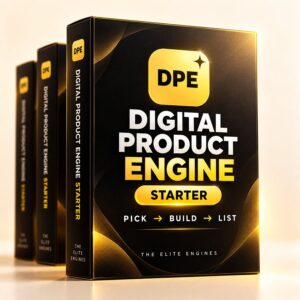
DPE Starter: build finished Etsy spreadsheet listings from 8 product types (working .xlsx, 7 to 9 listing photos, a video, title, 13 tags and description), plus DPE Core…
- Build spreadsheet templates for Etsy in eight formats: Personal Budget, Debt Payoff, Meal Planner, Fitness, Habit and Journal, Wedding Planner, Move Planner, and Con
- Export a working .xlsx workbook, CSV files and a Notion import file.
- Generate 7 to 9 listing photos, a listing video, title, 13 tags and a description in each listing kit.
- Create spreadsheet templates with formulas and editable settings.
- Organize downloadable files and test spreadsheet workflows before listing them for sale.
- DPE Starter: build finished Etsy spreadsheet listings from 8 product types (working .xlsx, 7 to 9 listing photos, a video, title, 13…
Digital Product Engine Review — research note: this review is based on the vendor’s public Help Hub, current public launch materials, and the product information available around the October 2026 launch. ReviewScoutLab is not claiming first-hand use or guaranteed results. Prices, credits, bonuses, and upgrade offers can change, so check the current WarriorPlus checkout before buying.
Related reading: How to Create Spreadsheet Templates for Etsy · How to Help Etsy Sellers Diagnose Listing Issues · Pin2Profit AI Review
Fit for U.S. Etsy sellers: what to verify
For a U.S.-focused Etsy shop, a generated spreadsheet listing is useful only if its final files work for the intended buyer. Before paying for Digital Product Engine, ask the vendor for an actual sample export and confirm whether USD number formatting, U.S. date conventions, and U.S. Letter printing can be configured. We have not independently tested those functions and do not present them as confirmed product capabilities.
Review the ZIP contents, Excel formulas, sample data, and Google Sheets import behavior before using AI-generated assets in a live listing. Etsy requires digital products to be made or designed by the seller, so buyers should check how a generated product fits Etsy’s digital-item guidance rather than assuming an automated export satisfies marketplace policies.
Check total costs, not just the software offer price: U.S. shop economics may also include Etsy listing fees, transaction fees, payment processing, taxes, and advertising. Etsy’s current official fee guide should be the source for those figures. For a manual benchmark before purchasing software, use our spreadsheet template creation guide and U.S. checklist. These are purchase-evaluation questions, not a claim that this product has been tested in a U.S. Etsy shop or that it will generate sales.
Quick verdict
Digital Product Engine, commonly presented as DPE Starter, is a cloud-based product-creation tool aimed at people who want to build spreadsheet-style digital products for Etsy. Instead of stopping at a workbook, the documented workflow is designed to produce a larger listing package: the spreadsheet files, listing images, a short listing video, a title, 13 tags, and a description. The official The Elite Engines Help Hub currently lists Digital Product Engine as a live Etsy-focused engine for spreadsheet kits, listing photos, and SEO copy.
Current public launch materials consistently list the DPE Starter front end at $12.95 as a one-time purchase with 650 credits. Those same launch materials state that a completed listing build uses 65 credits, which would make the starter balance enough for roughly ten builds. Treat those figures as current launch information rather than a permanent promise: WarriorPlus pricing, bonuses, credits, and funnel offers can change.
The strongest part of the offer is the attempt to compress several repetitive tasks into one workflow. The main limitation is equally important: producing files and listing assets does not prove that an Etsy niche has demand, that a spreadsheet is error-free, or that the listing will sell. A buyer still needs to review formulas, confirm compatibility, check the listing copy, and make an independent market decision.
What is Digital Product Engine?
Digital Product Engine is part of The Elite Engines ecosystem. The vendor’s public Help Hub describes it as an Etsy digital-product engine focused on spreadsheet kits, listing photos, and SEO copy. Current launch materials identify Dave Espino and Anil Krishna with the October 2026 launch and position DPE Starter as the entry offer sold through WarriorPlus.
The practical idea is simple: choose a spreadsheet product type, describe the version you want, choose a visual direction, generate the build, and review the resulting files. The product is therefore closer to a packaged Etsy-listing workflow than to a plain spreadsheet template library. It is intended to reduce the number of separate tools and manual steps needed between an idea and a listing-ready package.
That distinction matters. A spreadsheet generator can save time on workbook structure, but Etsy sellers also need presentation assets, listing copy, delivery files, and buyer-facing instructions. DPE attempts to connect those tasks. Whether that connection is valuable depends on how much of your current process is repetitive and how comfortable you are checking AI-generated outputs before publishing them.
How DPE Starter works
Based on current product materials, the workflow starts by selecting one of eight spreadsheet-focused product types. You then describe the intended version and audience, choose a style, and generate the package. Public launch documentation says a completed build can include a working Excel workbook together with additional export formats and listing assets.
The sensible way to use a tool like this is not to accept every generated element automatically. Start with a narrow product brief, generate one build, and then inspect the workbook tab by tab. Check formulas with known-answer examples, look for broken references, confirm that editable cells are clear, and test the final file in the spreadsheet application you intend to support. The same quality-control step should be applied to the listing title, tags, description, images, and video.
DPE also includes planning material referred to in current launch pages as DPE Core Five. Those materials are described as five short guides covering what to sell, who buys it, where to sell, when to launch, and how to sell, plus a 60-idea planner. This gives the offer a planning layer in addition to generation, although it should not be confused with verified marketplace demand data.
What you get
Current public launch information describes DPE Starter as including the spreadsheet builder, the listing kit, DPE Core Five, the 60 Ideas & Planner, a saved-products area, and an initial credit balance. The exact bundle can change, so the checkout page remains the final source for what is included with a purchase on a given day.
- A generated spreadsheet workbook in .xlsx format.
- CSV exports associated with the workbook’s tabs.
- A Notion-oriented import file or export material listed in current launch documentation.
- Seven to nine listing images depending on the documented build variation.
- A short listing video for the Etsy listing workflow.
- An Etsy-oriented title, 13 tags, and product description.
- Planning guides grouped under DPE Core Five.
- A 60-idea planning resource described in the launch materials.
- An initial credit balance currently listed as 650 credits.
Those outputs are useful only if they are accurate and match the product you actually deliver. Sellers should compare screenshots with the final workbook, remove unsupported claims, confirm that the listing description matches the files in the download, and make sure the generated tags describe the product rather than merely chasing search phrases.
The eight spreadsheet product types
Current launch pages consistently describe eight starting product types: Personal Budget, Debt Payoff, Meal Planner and Grocery, Fitness Tracker, Habit and Journal, Wedding Planner, Move or Relocation Planner, and Content Calendar. These are starting structures rather than eight single finished products, so the commercial usefulness depends on how specifically you adapt each build to a buyer and use case.
For example, “meal planner” is too broad to be a complete product strategy. A seller might instead create a weekly meal planner for a two-person household, a meal-and-grocery planner for students, or a family planner with a fixed grocery allowance. The same principle applies to the other categories. DPE can reduce construction time, but product positioning still requires human judgment.
That is also why duplicate-looking output is a risk. If many sellers use the same broad archetype with minimal customization, their products can become difficult to differentiate. Better results are more likely to come from a specific audience, a clearly defined problem, and careful editing of the generated workbook and listing assets.
Credits and pricing
At the time of this review, current public launch materials list DPE Starter at $12.95 one time with 650 credits. The same materials state that a finished listing build uses 65 credits, implying roughly ten initial builds if the stated credit cost remains unchanged. Some launch pages also describe optional credit packs and upgrades, including a monthly plan, but those are more likely to change and should be verified at checkout rather than treated as fixed.
The important buying question is not simply whether $12.95 is low. It is whether the first ten or so builds would replace enough manual work to justify the cost for your workflow. If you already have polished spreadsheet templates, image systems, video templates, and a listing-copy process, the benefit may be smaller. If you are starting from a blank workbook every time, the integrated workflow can be more meaningful.
Also remember that Etsy fees, design work, testing time, marketplace research, and any optional DPE upgrades are separate from the front-end price. The software does not remove those costs or responsibilities.
Listing assets and Etsy workflow
One of DPE Starter’s clearest selling points is that the workflow extends beyond the workbook. Current launch materials describe a build that can produce listing images, a short video, title, 13 tags, and a description along with the spreadsheet files. That can reduce handoffs between a spreadsheet tool, an image editor, a video tool, and a separate copywriting workflow.
However, “generated” is not the same as “ready without review.” Listing images should accurately show the workbook the buyer will receive. The video should not demonstrate a feature missing from the download. The title and tags should describe the actual product, and the description should state compatible applications and delivery format accurately. If a generated image looks more polished than the real workbook or shows screens that are not included, replace it.
For a practical quality-control workflow, see How to Create Spreadsheet Templates for Etsy. It covers workbook testing, packaging, screenshots, and release checks that still matter even when a generator handles the first draft.
Main strengths
1. It combines several production steps
The value proposition is not a single spectacular feature. It is the combination of workbook creation, export files, listing images, video, and listing copy. That can reduce repetitive setup work for sellers producing multiple spreadsheet-based products.
2. The starting product types are easy to understand
Budgets, meal planners, habit trackers, wedding planners, moving planners, and content calendars are familiar digital-product formats. A beginner can understand what they are trying to build without first learning a complex product taxonomy.
3. The credit model is relatively concrete
Current launch information gives a numerical starting balance and a reported cost per finished build. That makes it easier to estimate how many initial experiments the front end is intended to support, although users should verify the current figures before purchase.
4. Planning resources are bundled with generation
DPE Core Five and the 60-idea planner can help a beginner move from “I want to sell digital products” toward a more specific product concept. They should be used as planning prompts rather than proof of demand.
5. The vendor publishes support and refund information
The official The Elite Engines Help Hub lists Digital Product Engine among its live tools, provides public help resources, and states that support tickets are handled by a real person. The vendor also publishes a 30-day money-back policy for its plans. WarriorPlus-specific purchase handling may still depend on the checkout terms.
Limitations and risks
Generation does not validate market demand
DPE can help produce a listing package, but it cannot guarantee that buyers are searching for the product, that your pricing is competitive, or that the niche has enough demand. Marketplace research remains separate from content generation.
Spreadsheet errors still need human testing
Any generated workbook should be tested with known inputs before sale. Check formulas, references, date behavior, currency formatting, protected cells, exports, and reset instructions. If you promise Excel and Google Sheets compatibility, test both versions rather than assuming that an .xlsx file will behave identically after import.
Listing assets can drift from the delivered product
AI-generated screenshots, mockups, or descriptions can overstate what is actually included. The seller is responsible for making sure images and copy match the release files.
Credits create an ongoing production cost
The starter balance is finite. Sellers planning a large catalog should compare the cost of additional credits or upgrades with a manual workflow and alternative tools.
The wider funnel can complicate the buying decision
Current launch materials describe optional upgrades beyond DPE Starter. Those upgrades may add capabilities, but the front-end decision should be based on what DPE Starter itself does for your workflow rather than on bonus stacks or fear of missing an upgrade.
Who should consider Digital Product Engine?
- Etsy sellers who specifically want to create spreadsheet-based digital products.
- Beginners who find the combination of workbook, graphics, video, and listing copy overwhelming.
- Creators who want to test several spreadsheet ideas without building every production asset from scratch.
- People willing to review and edit AI-generated files instead of treating them as final automatically.
- Sellers who value a repeatable product-production workflow more than deep manual customization.
Who should skip it?
- Anyone expecting software to guarantee Etsy sales or passive income.
- Sellers whose products are not primarily spreadsheet-style digital downloads.
- Advanced spreadsheet designers who already have efficient templates, asset systems, and listing workflows.
- People who will not test formulas, compatibility, images, and listing claims before publishing.
- Buyers who need a fixed long-term price or unlimited creation without checking the current credit model.
Value assessment
On the currently advertised $12.95 front-end price, DPE Starter is inexpensive compared with the time required to manually create a workbook, multiple listing images, a video, and full listing copy. That does not automatically make it a good purchase. The real value depends on whether the generated output is close enough to your standard that editing takes less time than building from scratch.
A reasonable test is to treat the first build as an evaluation project. Pick one narrow product, generate the package, and measure how much manual repair is required. If formulas, screenshots, copy, and packaging all need major rebuilding, the apparent time savings are smaller. If the output is structurally sound and only needs normal editing, the tool may be useful for a repeatable catalog workflow.
Do not evaluate value based on the number of files alone. A smaller, accurate product that buyers can understand is more useful than a large package filled with generic assets.
Pros and cons
Pros
- Focused on a concrete Etsy workflow rather than generic content generation.
- Current materials describe eight understandable spreadsheet product types.
- Combines workbook creation with listing images, video, title, tags, and description.
- Includes planning resources for product ideas and selling decisions.
- Current front-end pricing is low enough for a small trial workflow.
- Official vendor help and refund resources are publicly available.
Cons
- No software-generated listing proves that a niche will sell.
- Workbook formulas and cross-platform behavior still require testing.
- AI-generated listing assets can misrepresent the final download if not checked.
- The starter credit balance is finite.
- Optional upgrades and changing launch prices can make the total funnel harder to compare.
- Users seeking highly bespoke spreadsheet design may still do significant manual editing.
Frequently asked questions
Is Digital Product Engine a scam?
Digital Product Engine is listed by The Elite Engines in its public Help Hub as a live Etsy-focused engine, and current launch materials document a WarriorPlus offer with defined product outputs and pricing. That supports treating it as a real commercial software offer. It does not mean every buyer will make money or that every generated product will be marketable.
How much does Digital Product Engine cost?
Current public launch materials list DPE Starter at $12.95 as a one-time front-end purchase. Verify the current WarriorPlus checkout because launch prices, coupons, bonuses, and upgrade offers can change.
How many credits are included?
Current launch materials list 650 starter credits and state that one finished listing uses 65 credits, which works out to roughly ten initial builds if the reported cost remains the same.
What does one DPE build create?
Public product materials describe a package that can include the .xlsx workbook, CSV files, Notion import material, seven to nine listing images, a short listing video, an Etsy title, 13 tags, and a description. Check the current product page for the exact files included at purchase.
Does it work with Google Sheets?
Current launch information says the generated spreadsheet workflow is intended for Excel and Google Sheets. Sellers should still test the actual exported file in both applications before advertising compatibility because formatting and formulas can behave differently after import.
Does DPE guarantee Etsy sales?
No. Product creation, keyword selection, pricing, competition, buyer demand, shop reputation, and marketing all affect results. A generator can reduce production work; it cannot guarantee marketplace demand or revenue.
Is there a refund policy?
The Elite Engines’ official public help resources state a 30-day money-back guarantee on its plans. For a WarriorPlus purchase, confirm the exact refund route and terms shown at checkout and in your receipt.
Final verdict — is Digital Product Engine worth considering?
Digital Product Engine is most interesting for a specific buyer: someone who wants to create spreadsheet-based Etsy products and would benefit from having the workbook, listing visuals, video, and copy produced in one coordinated workflow. Current launch materials make the front end easy to understand: eight spreadsheet product types, a listing kit, planning resources, and 650 credits at a currently advertised $12.95 one-time price.
The reason to buy is workflow compression, not a promise of sales. The reason to hesitate is quality control. Every generated spreadsheet should be tested, every image should match the file, every claim should be checked, and every listing still needs a real market rationale. If you are comfortable doing that review work, DPE Starter may be a practical way to accelerate early product experiments. If you want a completely hands-off Etsy business, it is the wrong expectation.
Disclosure: This review contains an affiliate link. If you purchase through it, ReviewScoutLab may earn a commission at no extra cost to you. That does not change the requirement to verify current price, terms, and suitability before purchasing.
Check the current Digital Product Engine offer on WarriorPlus
Disclosure: This article may contain affiliate links. If you purchase through them, we may earn a commission at no extra cost to you.
Bought Digital Product Engine Through Our Affiliate Link? We’re Here to Help
If you purchased Digital Product Engine through our affiliate link and you experience any problem with the product, you are welcome to contact us.
Whether you need help with installation, accessing the product, understanding how a feature works, contacting the product owner or vendor, reporting a technical problem, locating your purchase, requesting a refund, or dealing with another issue related to Digital Product Engine, we will do our best to guide you toward the appropriate solution.
You can contact ReviewScoutLab directly:
WhatsApp: +91 7889856565
Email: support@reviewscoutlab.com
We want readers who purchase through our affiliate links to know that our relationship does not end after the click. If you have a genuine problem, contact us and we will try to help you understand the next steps or reach the appropriate seller, platform, or support team.