SiteForge – Powerful Website Creation at a Glance
What You Get With SiteForge – Powerful Website Creation
Product information and buying considerations for SiteForge – Powerful Website Creation.
- AI & Software
- Product category: AI & Software
- Buyer check: compare the official feature list with your needs.
- Buyer check: confirm supported devices and platforms.
- Buyer check: review account and setup requirements.
- Buyer check: check current access and delivery details.
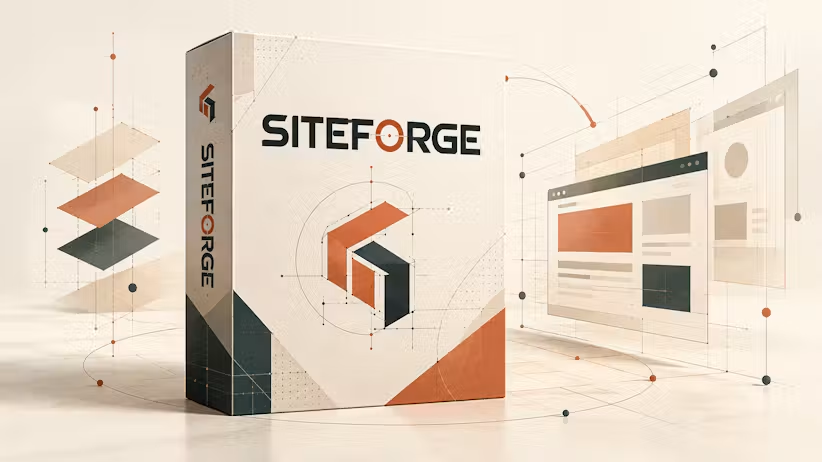
SiteForge – Powerful Website Creation Review: If you want a clearer brief before asking AI to build your site, this review explains what SiteForge claims to do, what is verified, and where information is missing.
What is SiteForge?
SiteForge – Powerful Website Creation is presented on its official product page as a guided workflow tool that helps users turn a website idea into a clear direction for AI-driven site builds. The product name is verified from the official product detail URL. Other product claims on the sales page are vendor statements and are noted below as such.
Product Video
Video detected on the vendor sales page. Availability and video content remain controlled by the vendor.
How SiteForge – Powerful Website Creation Works
Vendor material describes SiteForge as a step-by-step worksheet or guided flow you complete before asking an AI to build your site. The stated purpose is to capture audience, offer, goals, visual direction and project context so the AI has a clearer brief to work from. This description is attributed to the vendor; independent verification of the exact inputs, outputs or integrations is not available in the supplied source facts.
Key features (vendor statements)
- Guided five-step workflow to define a website direction before building (vendor states).
- Structured prompts for choosing website type and project starting point (vendor states).
- Options to describe visual style, audience, goals and primary actions for the site (vendor states).
- Compatibility claim: designed to work alongside the AI tools you already use (vendor states).
- Includes templates or presets for multiple website types (the vendor lists “10 website types” on the sales page; vendor statement).
- Resale rights claimed as an included launch bonus (vendor states this on the product page).
Benefits & practical use cases
Based on the vendor’s stated workflow, possible benefits may include:
- Faster briefing: a structured brief can reduce back-and-forth with an AI builder or designer.
- More consistent output: defining audience, goal and visual direction first may help get closer to the intended result from a single build pass.
- Flexible starting points: the vendor describes support for brand-new projects, existing sites, design direction or reference sites as different starts.
These are reasonable practical uses derived from the documented claims. They are editorial analysis, not independent verification of performance.
Limitations & unknowns
- Most functional details are vendor-provided and marked as vendor claims. The supplied reviewed sources does not include independent testing, screenshots of the interface, or technical documentation to verify how outputs integrate with specific AI builders.
- No verified pricing, licensing details, or long-term support terms are provided in the verified facts. The sales page mentions a launch price and bonuses; treat those as vendor statements until confirmed directly on the product page.
- There is no first-hand testing evidence supplied. Statements about improved AI output quality or time savings are not independently corroborated here.
Who it may suit / Who should skip it
May suit
- People who already use AI to build websites but struggle to write precise briefs.
- Designers or small teams that want a repeatable decision checklist before starting an AI build.
- Anyone who prefers planning and structured templates before handing work to an AI tool.
May want to skip
- Users who already have an established, reliable brief process and don’t need added structure.
- Buyers who require verified integrations, technical docs or sample outputs prior to purchase—those materials are not included among the verified facts supplied here.
Pricing & support notes
The official product page referenced in the reviewed sources contains vendor pricing language (launch price and bonuses). Those are vendor claims and are unverified in the available documentation. Readers should confirm current price, license terms, support channels and refund policy on the official product page before purchasing.
Alternatives to consider
If your goal is to produce better AI briefs or templates for website builds, consider tools or approaches that are known in this space: dedicated brief templates, design-brief checklists, or project-workflow tools (e.g., brief templates in Google Docs, Notion templates, or agency intake forms). The supplied reviewed sources does not list direct competitor products, so the examples above are editorial guidance rather than product recommendations tied to SiteForge’s claims.
SiteForge – Powerful Website Creation FAQs
Is SiteForge a website builder?
Based on the official product page text, SiteForge is described as a planning/guidance workflow rather than a drag-and-drop hosting builder. The vendor positions it as a way to prepare briefs for an AI builder.
Does SiteForge replace ChatGPT or other APIs?
The vendor explicitly states SiteForge is not a replacement for the AI you already use. It is presented as a planning layer to make your prompts more effective.
Is resale rights inclusion verified?
The sales page claims resale rights are included as a launch bonus. That is a vendor claim; verify the exact licensing terms on the product page before assuming resale permission.
Decision-support: how to evaluate whether SiteForge is worth testing for you
The existing review verifies the product name and summarizes vendor claims but leaves many practical decision points unconfirmed. Use the checklist and questions below to decide whether to investigate SiteForge further before purchasing or onboarding it into your workflow. These items are framed to work with the vendor claims (not as independent confirmations) and to help you spot the information you should confirm on the official product page or in a demo.
1) Clarify the exact output format and integration points
- Ask the vendor: what is the primary output of the SiteForge workflow? (Examples: a downloadable text brief, JSON prompt package, Notion page, Google Doc, or direct export to a page builder.)
- Confirm whether the output is intended to be copy-pasted into your AI tool, or whether there are built-in connectors for specific AI builders. The available documentation do not verify integrations.
2) Look for sample briefs and walkthroughs
- Request or inspect sample completed briefs (e.g., one for an e-commerce landing page, one for a local service site). Samples show the level of detail the tool encourages and help you judge potential time savings.
- If no samples are available, treat claims about improved AI output as unverified until you can test with your own prompts.
3) Confirm licensing and resale conditions
- The vendor page claims resale rights are included as a launch bonus; that is an unverified vendor statement in the available documentation. If resale or agency use matters to you, ask for written license terms that define permitted uses, restrictions and any required attribution.
4) Check support, updates and refunds
- Ask about support channels (email, chat, community), update cadence, and whether there is a refund window. The supplied reviewed sources does not confirm these operational details.
5) Trial or refund test
- If possible, request a trial or use a short refund window to test it with a real brief. Use one of your actual AI builds so you can compare outcomes side-by-side (with and without SiteForge-derived briefs).
Practical workflow: how to use a planning workflow like SiteForge with your existing AI site-builder
The vendor frames SiteForge as a five-step guided workflow to create a clearer brief for AI site builds. Below is a generic but practical workflow you can follow when using a planning tool of this kind. Use it to structure pilot tests and to measure whether SiteForge actually improves your results.
Step A — Gather project context before using the planner
Before you run through a guided worksheet, assemble the raw inputs your project already has. Typical inputs include:
- Business overview (one-sentence value proposition)
- Primary conversion goal (lead capture, purchase, booking, information)
- Top competitor or reference URLs
- Existing brand assets (logo, color codes, fonts) or a note that none exist
- Target audience profile (job title, pain points, demographics, tech comfort)
Having these ready makes it faster to complete a structured brief and avoids vague answers that reduce the value of the worksheet.
Step B — Complete the guided brief carefully
When you work through the five-step flow (as the vendor describes), aim for specificity. Useful habits:
- Instead of “professional” for style, give two adjectives and an example site: e.g., “clean, open layout like example.com with neutral blues and high-contrast CTAs.” If you don’t have an example site, name a brand or industry aesthetic you like.
- For audience, avoid broad descriptions like “small businesses.” Narrow to industry, decision-maker, and one pain point (e.g., “independent photographers who need fast client galleries and basic e-commerce”).
- Define the single most important action you want visitors to take on each key page (e.g., “contact form completion on the homepage; checkout on product pages”).
Step C — Convert the brief into an AI prompt template
Assuming SiteForge produces a brief or a prompt structure, turn that into a repeatable prompt template for your chosen AI tool. Components of a good template:
- Context: one-sentence business summary
- Audience and problem to solve
- Desired pages and their primary actions
- Visual direction examples and accessibility notes
- Tone of voice and word-count targets for headlines and sections
Example: paste the generated brief into your AI builder and prepend the instruction: “Act as a senior web copywriter and front-end developer. Using the following brief, create: 1) a homepage hero headline + subhead, 2) an above-the-fold layout description, 3) two feature section layouts with copy, and 4) a page-level outline for SEO.” Adjust the prompt to match the capabilities of your AI tool.
Step D — Iterate on outputs and capture changes back into the brief
Use the first AI output as a draft. Evaluate it against the brief: does it respect audience, tone, and primary calls to action? If not, refine the brief or add clarifications, then re-run. Keep a version history of your brief so you can reproduce the approach for future clients or projects.
Step E — Operationalize for handoff or build
If you hand briefs to developers, designers, or other AI prompts, export the completed brief to a shareable format (document, Notion page, or JSON). Include annotated acceptance criteria: what constitutes a complete landing page or a successful build. The available documentation do not confirm whether SiteForge includes automated exports, so plan for manual copy-paste if needed.
Comparisons: how a planning workflow like SiteForge differs from alternatives
Below are typical alternatives to a guided planning product and how they compare in practical terms. The vendor claims SiteForge offers a five-step structure and templates; those are vendor statements in the available documentation. Use this comparison to decide which approach matches your needs.
1) Using plain brief templates (Google Docs / Notion)
Pros:
- Complete control and flexibility over questions and structure.
- Easy to share and version-control inside your organization.
Cons:
- Requires manual discipline to ensure consistency; not guided step-by-step.
Fit: if you prefer full customization and already have repeatable processes, a simple template may be sufficient.
2) Agency intake forms or CRM-integrated briefs
Pros:
- Often capture billing and client metadata alongside project needs; good for managed services.
Cons:
- May be heavy-weight for single-person use or rapid prototyping.
Fit: if you need to combine business admin with creative briefs, an agency intake approach is better.
3) AI prompt marketplaces and prebuilt prompt packs
Pros:
- Prompts are often optimized for particular AI models or builders and can include examples.
Cons:
- May be narrow in scope and not focused on the broader project planning that a five-step worksheet would provide.
Fit: use this when you want quick, model-ready prompts rather than a planning checklist.
4) Dedicated design systems or component libraries
Pros:
- Provide consistent UI components and speed up the build once designs are decided.
Cons:
- Do not replace the need for strategic direction or copy and audience targeting.
Fit: use these after you have a clear brief and need to move into implementation.
Summary: a guided planning tool can add value if you lack a repeatable structure, want faster briefing for AI builders, or benefit from templates. If you already have a mature brief process or tight technical integrations are critical, compare whether SiteForge adds unique value beyond your existing templates and systems.
Buyer-fit: who should seriously consider trying SiteForge and who should probably skip it
The review lines up possible target users and people likely to benefit. Below is a practical buyer-fit matrix to map real-life needs to expected outcomes. These are inferential guidelines based on the vendor positioning and the verified fact that SiteForge is described as a planning workflow; they are not independent confirmations of performance.
High-fit profiles (likely to benefit)
- Individuals or small design teams that frequently generate AI site builds and need a repeatable brief template to reduce rework.
- Freelancers who sell quick-turn landing pages and want a checklist to capture client needs consistently across projects.
- Beginners who are learning how to brief AI tools — a guided five-step flow can teach the questions that matter most (audience, goal, visual direction).
Moderate-fit profiles
- Designers who already use briefs but want to experiment with a more structured prompt format. They should validate whether the tool integrates cleanly into their existing handoff processes.
- Small agencies that might use the product internally if the license allows team redistribution — verify resale or multi-seat rights before relying on it for client work.
Low-fit profiles (may want to skip)
- Teams that require verified technical integrations to their internal tools (CI/CD, page builders, or proprietary AI pipelines). The available documentation do not verify such integrations.
- Buyers who need proof of measurable outcomes (e.g., documented time savings or conversion lifts) before purchasing. There is no independent testing included in the supplied information.
Validation checklist to use while reviewing the product page or demo
Use the list below during vendor conversations, demos, or when reading the product page. The available documentation mark most functional claims as vendor-provided; these are the items you should confirm directly.
- Exact export formats — does SiteForge produce plain text, structured JSON, documents, or integrations with specific platforms?
- Template coverage — the vendor lists “10 website types” as a claim; ask to see the list and examples for each type.
- Resale and licensing terms — get these in writing if you plan to use SiteForge outputs commercially or resell materials.
- Team and multi-seat options — does the product support team accounts or collaboration features?
- Update policy and roadmap — how often is the product updated and is there a published feature roadmap?
- Support and community — what channels are available and is there an active community or knowledge base?
- Refund policy or trial — confirm whether you can test the product risk-free before committing.
Extended FAQ (clarifying gaps left by the verified facts)
Q: Will SiteForge directly build or host my website?
A: According to the vendor messaging summarized in the available documentation, SiteForge is positioned as a planning layer to create briefs for AI builders, not as a hosting or drag-and-drop site builder. The supplied material does not verify any hosting or direct-build functionality. If you need hosting or one-click deployment, confirm whether SiteForge offers exports compatible with your chosen platform or whether additional tools are required.
Q: Does SiteForge work with ChatGPT, Bard, or specific AI builder tools?
A: The vendor claims SiteForge is “designed to work alongside the AI tools you already use,” but the available documentation do not verify explicit integrations or model-specific optimizations. Ask for examples of prompts optimized for the AI model you use, or test by running a sample brief through your AI workflow to compare results.
Q: Can SiteForge replace an agency brief or a senior strategist?
A: A structured planning tool can standardize the intake process and reduce some strategic overhead, but it is unlikely to replace senior strategic thinking for complex projects. The tool is described as a worksheet to clarify direction; for high-stakes projects (large platforms, multi-phase marketing funnels), plan to supplement any generated brief with human strategy and review.
Q: Are the templates customizable?
A: The vendor describes templates or presets as included, but the available documentation do not confirm how editable those templates are. If customization is important, ask whether you can modify the templates and save custom versions for reuse.
Q: How repeatable are the briefs across similar projects?
A: A five-step guided flow should increase repeatability by prompting the same questions each time, but repeatability depends on the granularity of the questions and whether the outputs are stored and versioned. If you want to create a library of briefs, confirm export and storage options with the vendor.
Q: What evidence exists that SiteForge reduces the number of AI revision cycles?
A: The supplied source facts do not include testing or metrics that prove fewer revision cycles. Treat claims about time savings or improved output as vendor statements until you can test with real projects.
Q: If I’m a developer, how much does a better brief help me?
A: Developers benefit when briefs are specific about functional expectations (forms, integrations, accessibility requirements, analytics tracking). Use the planning workflow to capture acceptance criteria and edge cases. Confirm that the brief format includes sections where you can record technical requirements — if not, plan to augment the brief with a technical checklist.
Practical experiments you can run in a short pilot (low-effort ways to test real value)
Before committing, run these small experiments to gather direct evidence of whether SiteForge improves your AI builds:
- Baseline test: take a recent site you built with AI and save the prompts you used. Re-run the same project by first filling out the SiteForge-style five-step brief (or the official demo brief) and then using the resulting brief as the prompt. Compare outputs for clarity, relevance, and number of iterations needed.
- Template test: pick two representative project types (simple landing page and multi-page brochure) and ask SiteForge for templates for each. Evaluate whether the templates reduce discovery time compared with your current process.
- Handoff test: create a brief with SiteForge and hand it to a colleague or contractor who doesn’t know the project. See how closely their initial result matches your expectations; that measures whether the brief communicates objectives clearly.
Record qualitative notes (time saved, clarity of output, missing information) so you can decide objectively if the tool pays for itself.
Final list of questions to ask the vendor or look for on the official product page
- Can you provide sample completed briefs for each of the 10 website types mentioned on the sales page?
- What file formats and export options are supported?
- How are resale rights structured, and can you share the exact license text?
- Are there team or multi-seat licenses and what do they cost?
- Is there a trial, demo, or refund window to test the product risk-free?
- What support channels are available and what is the expected response time?
- Are there any case studies or independent testimonials demonstrating measurable improvements?
As you gather answers, prioritize the items that affect your core concerns (licensing for agencies, export formats for developers, and sample outputs for anyone who wants to reduce AI revisions).
How to decide after your due diligence
If your pilot tests show clearer AI outputs, fewer iterations, and a workflow that fits your handoff needs, SiteForge-style planning tools can be a worthwhile efficiency investment — especially for small teams and freelancers who handle many small projects. If the tests reveal limited export options, unclear licensing, or no measurable improvement in output, you may be better off building a tailored template in your existing tooling (Notion, Google Docs) or refining your current intake process.
Related reading: Short Drama Creator AI Review: Unleashing Your Creativity · PromptDex AI Prompt Workspace Review: Features & Limits · The AI Continuity Vault Review: Features and Limits
Reference: FTC endorsement and review guidance.
Is SiteForge – Powerful Website Creation Worth It? Our Verdict
SiteForge – Powerful Website Creation appears to be a focused planning workflow aimed at improving the brief you give to AI builders. The product name and existence are verified from the product page. However, most functional and commercial details (features, price, resale rights, examples of output and integrations) come from vendor material and remain unverified in the supplied sources. If you frequently use AI to build or redesign sites and struggle to convert ideas into precise prompts, SiteForge may be worth investigating further—start by reviewing the official product page, sample walkthroughs, and any available demos before buying.
Next step
Check the official product page for the latest price, demo and stated license details. Disclosure: this article may contain affiliate links; we may earn a commission if you purchase through them at no extra cost to you.
Disclosure: This article may contain affiliate links. If you purchase through them, we may earn a commission at no extra cost to you.
Practical tutorial: How to organize the key decisions you must make before asking AI to build your site.
Educational guides connected with SiteForge – Powerful Website
Preview of category-related educational resources. Bonus access follows the posted terms.
Explore 10 practical eBooks packed with guides, templates and checklists selected for Independent Buyer Guides.
Discover helpful shortcuts, ideas and ready-to-adapt resources you might otherwise spend hours gathering separately.
Purchase eligibility is verified before bonus access is sent. Affiliate link.
Independent Buyer Guides | Starter Blueprint
A simple orientation plan to understand the moving pieces and take sensible first steps. Includes checklists, guided questions, a decision scorecard and a four-week plan.
Independent Buyer Guides | Decision Guide
Practical questions and tradeoffs to evaluate options without relying on hype. Includes checklists, guided questions, a decision scorecard and a four-week plan.
Independent Buyer Guides | Workflow Playbook
Repeatable processes and checkpoints that make daily work clearer. Includes checklists, guided questions, a decision scorecard and a four-week plan.
Independent Buyer Guides | Questions That Matter
Better questions to uncover gaps, hidden costs and important limitations. Includes checklists, guided questions, a decision scorecard and a four-week plan.
Independent Buyer Guides | Common Mistakes Field Guide
Recognize avoidable missteps and recover with a measured approach. Includes checklists, guided questions, a decision scorecard and a four-week plan.
Independent Buyer Guides | Comparison Workbook
Editable-style worksheets for scoring features, fit and long-term value. Includes checklists, guided questions, a decision scorecard and a four-week plan.
Independent Buyer Guides | 30-Day Action Planner
An achievable four-week plan with review points and clear priorities. Includes checklists, guided questions, a decision scorecard and a four-week plan.
Independent Buyer Guides | Quality Checklist
A documented review framework to catch issues before they become expensive. Includes checklists, guided questions, a decision scorecard and a four-week plan.
Independent Buyer Guides | Measurement Toolkit
Focus on useful signals rather than vanity metrics or impressive claims. Includes checklists, guided questions, a decision scorecard and a four-week plan.
Independent Buyer Guides | Next-Level Roadmap
Prioritize sustainable improvements after the essentials are in place. Includes checklists, guided questions, a decision scorecard and a four-week plan.
Bought SiteForge – Powerful Website Creation Through Our Affiliate Link? We’re Here to Help
If you purchased SiteForge – Powerful Website Creation through our affiliate link and you experience any problem with the product, you are welcome to contact us.
Whether you need help with installation, accessing the product, understanding how a feature works, contacting the product owner or vendor, reporting a technical problem, locating your purchase, requesting a refund, or dealing with another issue related to SiteForge – Powerful Website Creation, we will do our best to guide you toward the appropriate solution.
You can contact ReviewScoutLab directly:
WhatsApp: +91 7889856565
Email: support@reviewscoutlab.com
We want readers who purchase through our affiliate links to know that our relationship does not end after the click. If you have a genuine problem, contact us and we will try to help you understand the next steps or reach the appropriate seller, platform, or support team.