Quick Answer
Product Details
Product information and buying considerations for The AI Continuity Vault.
- Buyer check: review seller support and update terms.
- Product category: Training/Course
- Buyer check: compare the official feature list with your needs.
- Buyer check: confirm supported devices and platforms.
- Buyer check: review account and setup requirements.
- Buyer check: check current access and delivery details.
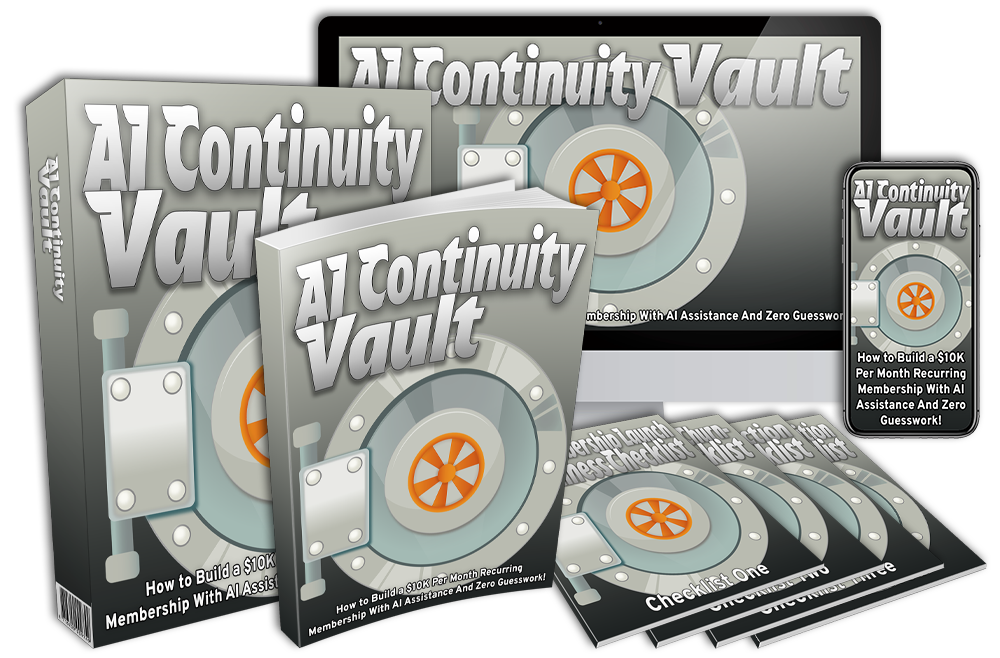
The AI Continuity Vault Review: If you’re weighing PLR (private label rights) content to build or sell membership products, this review summarizes what is documented about The AI Continuity Vault, what the vendor says it includes, and the key limits a buyer should confirm before buying.
Quick summary
The AI Continuity Vault is presented as a rebrandable PLR package for creating AI-powered membership sites. The sales material claims a 63-page guide with editable private-label rights, an AI prompt appendix, templates and four bonus checklists. Those vendor claims come from the official product page and are treated as vendor statements below; independent verification and hands-on testing are not available in the supplied material.
What is The AI Continuity Vault?
According to the product page, The AI Continuity Vault is a ready-made, rebrandable package designed to help people create membership-style products using AI-related content and automation. The vendor positions it as a done-for-you PLR system you can rebrand, split up, or resell.
What’s claimed to be included (vendor statements)
These are the features described on the sales page. Treat them as vendor claims unless you verify them directly on the product page or via the vendor:
- 63-page, 14,338-word step-by-step guide across 12 chapters plus appendices (claimed).
- Full Private Label Rights (PLR) allowing rebranding and resale (claimed).
- The AI Prompt Vault: 28 copy-paste prompts for curriculum, copy, email automation, retention and JV outreach (claimed).
- Four done-for-you bonus checklists covering launch readiness, retention, AI production, and member acquisition (claimed).
- Templates, swipes and a filled 12-month calendar for content and funnel use (claimed).
- Resource directories and example curriculum to speed setup (claimed).
How it is supposed to work
Based on the documented sales description, the package is intended to be downloaded, rebranded, and used as content for a membership site or sold as a product. The claimed prompt appendix and templates are presented as practical assets buyers can paste into AI tools and marketing funnels. Again, these are vendor statements and should be confirmed on the product page.
Practical benefits (analysis)
If the vendor claims are accurate, buyers who need ready-made content could save time by rebranding and publishing this material instead of creating long-form content from scratch. The prompt library and templates—if present and useful—could reduce the technical friction of designing email sequences, curriculum and launch pages. PLR licensing can also let buyers keep proceeds from resales if the license terms are as stated.
Important limitations and unknowns
- No independent testing: There is no supplied first-hand evaluation of content quality, accuracy, or completeness.
- License details: The sales copy states PLR rights, but the exact license terms (restrictions, permitted uses, resale platforms, included file formats) must be verified in the product license or terms before purchase.
- Content quality and freshness: The vendor claims a large word-count and structured chapters, but content quality, practical accuracy, or depth are unverified here.
- Support and updates: Available product information does not confirm update frequency, support channels, or whether updates to AI prompts are included.
- Commercial claims: Any revenue examples or earnings-related language on the sales page are vendor marketing; they are not independently validated by ReviewScoutLab.
Who this may suit
- Small creators who want a fast, rebrandable PLR package to populate a membership or product funnel.
- Marketers who prefer editing and customizing prewritten content rather than writing from scratch.
- Agencies or freelancers who need templates and AI prompt collections for client work (after verifying license use for client resale).
Current The AI Continuity Vault Bonuses
These are the current bonus details ReviewScout could verify from the vendor sales page on October 14, 2026. Bonus availability can change, so confirm the live affiliate offer before purchasing.
Bonus 1: Bonus #1
Bonus 2: Bonus #2
Bonus 3: Bonus #3
Bonus 4: Bonus #4
Who should be cautious or avoid it
- Buyers who require independent evidence of content quality, up-to-date AI workflows, or real-world case studies — none are provided in the supplied facts.
- Anyone who cannot confirm the license permits their intended commercial use (some PLR packages include restrictions).
- Advanced creators who prefer bespoke content rather than PLR, or who need integrations and live software rather than a content pack.
Buyer checklist — 5 questions to ask before purchasing
- Can I review the exact license text before buying? Confirm permitted uses and any resale restrictions.
- What file formats are included (editable source files, Word/Google Docs, images, templates)?
- Are the AI prompts tested or documented with intended prompt-engine/tool examples?
- Is there post-purchase support or update access if AI best practices or platforms change?
- Can I see a sample chapter or content excerpt to assess writing quality and relevance?
Alternatives to consider
If you need verified content quality or platform-integrated solutions, consider these general alternatives (examples of approaches, not vendor endorsements):
- Create custom content with a professional ghostwriter or content agency (higher cost, bespoke work).
- Buy smaller, topic-specific PLR packs and assemble a tailored membership curriculum yourself.
- Use membership-platform-specific templates and paid course creators that include hosting and automation tooling rather than only content files.
Evidence note
Verified facts used in this review are limited to the product name and the presence of marketing claims on the official product page and site documentation. Marketing claims about word counts, PLR terms, prompts and bonuses are attributed to the vendor and marked as unverified in the facts list below. No independent first-hand testing or third-party reviews were supplied.
Pros and cons (balanced view)
Pros
- Designed to be rebrandable and resellable (vendor claims).
- Includes a prompt appendix and templates that could speed setup (vendor claims).
- Targets the evergreen idea of membership/recurring revenue combined with AI content topics (vendor positioning).
Cons
- Content quality and depth are unverified here — buyers should preview samples.
- Exact PLR license terms and permitted commercial uses must be confirmed.
- No supplied evidence of ongoing updates, support, or proof that prompts work across current AI tools.
Frequently asked questions
Is The AI Continuity Vault legitimate?
The product page exists and markets a PLR package; that indicates a commercial offer. This review did not find independent third-party testing or user reviews in the supplied material, so verify the product page, license text and any sample content before purchase.
Will this save me time creating a membership?
Potentially — if the claimed assets (guide, prompts, templates) match your needs. But the time saved depends on content quality and whether the materials are ready-to-publish or require substantial editing.
Does the license let me sell the content and keep 100%?
The sales copy claims full PLR rights and keeping 100% of sales, but you must review the actual license terms included with the product to confirm scope, limitations and any resale restrictions.
Decision guide: Who should seriously consider buying this PLR pack — and who probably should not
The existing review lists broad buyer categories, but here is a more practical decision guide that ties buyer goals to likely outcomes. Use this to decide whether the AI Continuity Vault (based on the vendor claims) is worth further investigation for your situation.
- Good match — You need a fast starting point and are willing to edit:
If your priority is speed and you are comfortable opening, editing and rebranding text files, then a PLR package that claims a full guide, templates and prompts can be useful. The claimed assets (guide, prompt appendix, templates) are structured to be adapted, so buyers who plan to (a) customize voice and examples, (b) swap in their own branding and (c) test the prompts in their preferred AI tools should find value—provided the claims are accurate.
- Good match — You sell information products or run small agencies:
Agencies or freelance professionals who assemble content for clients may benefit from reusable templates and prompt libraries if the license actually permits client-facing use. Confirm the license before assuming client resale or white-labeling is allowed.
- Less suitable — You require turnkey, platform-integrated solutions:
If you expect a hosted membership site, integrated automation, or step-by-step technical walkthroughs for specific platforms (e.g., screenshots tied to a particular LMS), a PLR content pack that delivers files and prompts is unlikely to meet that need unless the package explicitly includes platform-specific guides. The supplied facts do not document such integrations.
- Less suitable — You need independently verified, up-to-date AI workflows:
The vendor claims include prompts and a prompt appendix, but the review does not contain independent testing. If your business relies on current, field-tested prompt engineering or on workflows tied to a particular model/version, treat the prompt library as potentially useful starting material but not a guaranteed, ready-to-run system.
Practical workflow: Turning a PLR pack into a working membership product
Assuming you decide the AI Continuity Vault’s claimed assets are worth buying, here is a step-by-step workflow to convert the raw PLR material into a polished membership offering. These steps highlight decisions you should make early and checkpoints to reduce wasted effort.
- Check the license immediately upon purchase (or request a sample license before buying):
Confirm permitted uses (resale, white-label, distribution channels), attribution requirements, file-type permissions, refund policy and any clauses about derivative content. If the license is ambiguous, ask the vendor for clarification in writing.
- Inventory included files and formats:
Open the package and catalog what you actually received: editable Word/Google Docs, source files for graphics, templates in HTML or a page-builder format, calendar files, and prompt lists. Editable formats significantly reduce friction; PDFs alone will cost more time to convert.
- Run a content quality and relevance audit:
Skim every chapter and template to identify outdated references, weak claims, or sections that conflict with your expertise. Mark passages to rewrite, examples to replace, and prompts to test. Expect to invest editing time; PLR is rarely drop-in ready for niche audiences.
- Test and adapt AI prompts in your chosen tool(s):
Copy the provided prompts into the AI tools you plan to use. Evaluate output quality for tone, factual accuracy, and alignment with your audience. Note prompts that need temperature, system messages, or context windows adjusted. Save improved prompt variants and document required model settings if any.
- Customize curriculum and delivery format:
Convert the guide into lessons, modules or drip content appropriate to your membership structure. Supplement PLR chapters with original material or updates where you have domain expertise. Decide whether content will be text-only, video, audio, or mixed, and plan to record or convert as needed.
- Design the funnel and onboarding flow:
Use the claimed templates and the 12-month calendar as baseline assets, but verify that email sequences, opt-ins, and sales pages match your voice and legal/compliance needs (privacy, disclaimers). A/B test headlines and onboarding copy before driving paid traffic.
- Deliver and monitor member experience:
Once launched, collect feedback from early users, track engagement metrics, and update content. Plan to refresh AI prompts if you rely on generated content; prompt drift and model updates can impact output over time.
Operational limitations and red flags to confirm before purchase
Beyond license wording and file formats, these are practical limitations and potential red flags to check so you don’t get stuck mid-build.
- Single-use vs. scalable license: Some PLR packs allow you to sell the content once, or with site-count limits, or exclude marketplace resale. Confirm whether the vendor allows unlimited resales and whether there are platform restrictions (e.g., restrictions on selling through Amazon or other channels).
- Updates and maintenance: AI content guidance can become outdated quickly. Ask whether the product includes updates to prompts or whether updates are an extra purchase. If no updates are provided, plan to maintain prompts and examples yourself.
- Hidden asset dependencies: Check for missing images, proprietary templates, or third-party tools referenced in the copy. If the materials reference paid tools, you may need additional subscriptions to fully implement the workflows.
- Quality variability: PLR packages can vary widely in writing quality and factual accuracy. Request a sample chapter for evaluation or ask for a refund policy window that allows a content quality check before committing users.
Comparisons and realistic alternatives — not vendor endorsements
When considering this PLR pack, compare it against other approaches that meet similar goals. The right option depends on budget, time horizon and required level of customization.
- Assemble your own curriculum from smaller PLR pieces: Buying multiple focused PLR modules and combining them can let you tailor a curriculum more precisely than a single large pack. This approach often requires more project management but yields a more niche-specific product.
- Hire a writer or course developer: If unique positioning or proprietary methods are central to your offer, commissioning original content may deliver higher conversion and fewer license headaches. This costs more but provides exclusivity.
- Use platform-native templates and integrations: Platforms that provide hosted course creation, payment processing and automation (even if they cost more) reduce technical friction and may be better for creators who prefer a managed environment over handling files.
Buyer-fit checklist: practical questions to answer before you click buy
Extend the five-question checklist already included in the review with these operational questions. Use them to request clarifications from the vendor or to check samples before purchase.
- Can I download a sample chapter and the prompt appendix to test quality and relevance before buying?
- Which exact file formats are provided (editable .docx/.gdoc, HTML, CSV for calendars, image sources) and are they included in the base package?
- Does the license explicitly permit selling the content on the platforms I plan to use? Are there geo or platform exclusions?
- Are prompts annotated with intended model types, token limits, or parameter recommendations, or are they generic copy-paste entries? (If generic, plan to perform model-specific tuning yourself.)
- Is post-purchase support offered (email, ticket) and for how long? Is there a stated update policy for prompt libraries or content refreshes?
- Does the pack include any media assets (images, icons, templates) with commercial-use licenses included, or are images placeholders requiring separate licensing?
- Are there suggested pricing or funnel examples included, and if so, are those examples independent claims or vendor marketing? (Treat any earnings claims as unverified.)
FAQ additions focused on implementation and licensing
Q: Do I need advanced AI knowledge to use the included prompts?
A: Not necessarily. Many PLR prompt libraries are designed to be copy-paste friendly for common AI chat interfaces. However, the effectiveness of those prompts depends on the model/version you use, the context you provide and any model-specific settings. If you are unfamiliar with prompt parameters (temperature, system messages, tokens), plan to spend time testing and iterating the prompts in your chosen tools.
Q: Will customers notice the content is PLR?
A: Potentially. PLR content is often sold to many buyers and can show up across multiple products unless you substantially customize it. To minimize detection and increase perceived value, rewrite sections to add unique examples, proprietary frameworks, or personal case studies.
Q: How much editing should I expect to do?
A: This varies. Some PLR packs are near-publish-ready; others require substantial rewriting. Plan for at least a content audit and moderate editing to align voice, update facts and remove generic language. If you plan to brand the content as your own flagship program, expect to invest more time to make it distinctive.
Q: Are PLR prompts reusable across different AI platforms?
A: Prompts can often be adapted across tools, but outputs vary with model architecture and settings. A prompt written for one model may need context adjustments or system instructions to perform similarly in another. Treat the prompt appendix as a starting point, not a one-size-fits-all solution.
Q: What legal or compliance checks should I do?
A: Verify licensing explicitly for commercial use, resale and client projects. Check for privacy or data-collection wording in any included email templates, and ensure you comply with local regulations for marketing and subscriptions (e.g., explicit consent for recurring billing). If you plan to give financial or medical advice through the membership, include appropriate disclaimers and consult legal counsel.
These added sections are intended to supplement the existing review with practical, buyer-focused guidance based on the vendor claims and the typical realities of converting PLR into a functioning membership product. They are not a validation of the vendor’s claims; verify samples, licensing and file formats directly with the seller before purchasing.
Related reading: Viral Cartoon Video Creator AI Review: Worth Buying? · Prompts To Profit (PLR) Review: Unlock Your Digital Goldmine · (AI Toolkit) The Launch & Presentation Engine PLR Review: Buyer Guide
Reference: FTC endorsement and review guidance.
Final verdict
The AI Continuity Vault appears to be a standard PLR-style package aimed at creators who want rebrandable membership content and supporting prompts/templates. The vendor lists sizable deliverables, but the supplied information is promotional and has not been independently verified by ReviewScoutLab. Interested buyers should first review the license text, request samples or previews, and confirm support and file formats. For buyers who accept PLR tradeoffs and validate the license and content quality, this could be a practical shortcut. For those needing verified results, bespoke content or software-integrated solutions, further due diligence is recommended.
Disclosure: This article may contain affiliate links. If you purchase through them, ReviewScoutLab may earn a commission at no extra cost to you.
Disclosure: This article may contain affiliate links. If you purchase through them, we may earn a commission at no extra cost to you.
Bought The AI Continuity Vault Through Our Affiliate Link? We’re Here to Help
If you purchased The AI Continuity Vault through our affiliate link and you experience any problem with the product, you are welcome to contact us.
Whether you need help with installation, accessing the product, understanding how a feature works, contacting the product owner or vendor, reporting a technical problem, locating your purchase, requesting a refund, or dealing with another issue related to The AI Continuity Vault, we will do our best to guide you toward the appropriate solution.
You can contact ReviewScoutLab directly:
WhatsApp: +91 7889856565
Email: support@reviewscoutlab.com
We want readers who purchase through our affiliate links to know that our relationship does not end after the click. If you have a genuine problem, contact us and we will try to help you understand the next steps or reach the appropriate seller, platform, or support team.
Practical tutorial: How to convert a 63-page PLR guide into a modular membership course.